
Reviewed · WALKING TOURS
Palma de Mallorca Private Guided Walking Tour
Palma’s old center packs centuries into a short walk. On this private tour, you move from the Ayuntamiento on Plaça de Cort through medieval lanes, Gothic churches, Moorish remains, and the grand Cathedral and Almudaina. It is a quick way to see how Talayotic, Roman, Islamic, and Christian Mallorca overlap in one compact district.
I like the private format, especially for families or small groups that want to ask questions and adjust the pace. I also like the broad sweep of the tour, from the wooden roof of the 17th-century town hall to the quiet Arab Baths. The main consideration is time: 90 minutes goes quickly, and entrance fees are not included.
In This Review
- Key points at a glance
- Starting at Palma’s Ayuntamiento
- From Talayotic Mallorca to Roman Palma
- Santa Eulalia and the medieval core
- The Gothic Convent of San Francisco
- The Arab Baths and Mallorca’s Moorish past
- The Cathedral and La Almudaina across from it
- Medieval lanes, aristocratic homes, and public squares
- What the private format changes
- Is $280 a fair price for 1.5 hours?
- Cristina’s helpful restaurant advice
- Who should book this Palma walk?
- Should you book the Palma de Mallorca Private Guided Walking Tour?
- FAQ
- Where does the tour begin?
- How long does the walking tour last?
- What language is the tour offered in?
- Is this a private tour?
- What sights are included in the route?
- Are entrance fees included?
- Can the tour be customized?
- How much does the tour cost?
- Can I cancel for a full refund?
- Do I have to pay when I book?
Key points at a glance
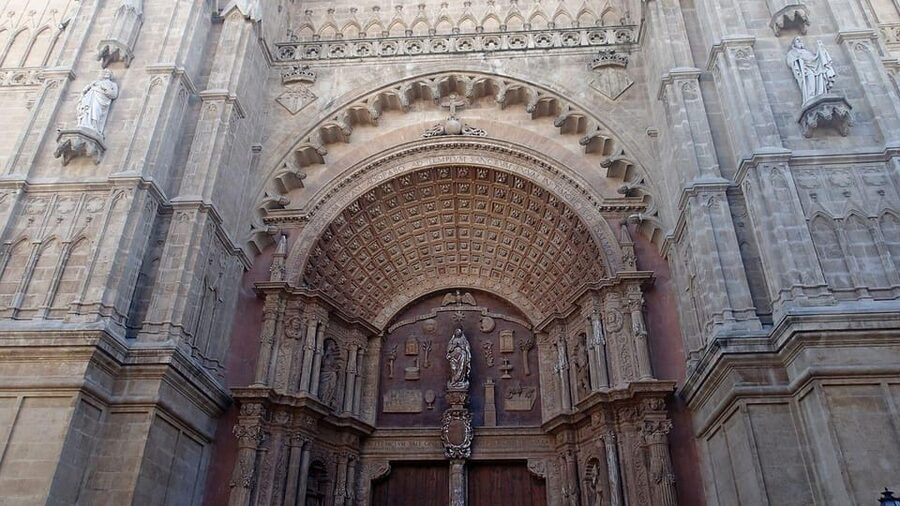
- Palma’s story spans several eras: Learn about Talayotic tribes, Roman rule, Moorish Mallorca, and the Christian kingdom in one walk.
- The meeting point is easy to find: Begin at the seating area of the Ayuntamiento on Plaça de Cort.
- Several major sights are viewed along one route: Santa Eulalia, San Francisco, the Arab Baths, the Cathedral, and La Almudaina all form part of the experience.
- You get a guide for your group only: The private format allows questions and possible adjustments on the spot.
- Cristina can add practical help: One booking party specifically praised her guidance and her recommendation and reservation of a good restaurant.
- The price favors groups: At $280 for up to 15 people, the cost is much better when shared by a full group than by one or two people.
Starting at Palma’s Ayuntamiento
The tour begins at the seating area of the Ayuntamiento, Palma’s city hall, at Plaça de Cort. This central square gives you a useful first look at the city’s civic heart before the route slips into the older streets.
The town hall dates from the 17th century and is known for its large wooden roof. That detail matters because it shows how Palma’s public buildings can look grand without relying only on stone facades and church towers. Your guide can place the building in the wider story of Palma, rather than treating it as a quick photo stop.
Plaça de Cort is also a practical meeting point. You do not need to search for a hotel lobby or a distant transport stop. You should arrive with enough time to locate the seating area and be ready for a walking route through the old center.
The exact order and amount of time spent at each sight can change, since the tour allows possible customization with your guide on the spot. That flexibility is useful if you want more architecture, more religious art, or more discussion of Mallorca’s changing rulers.
More things to do in Palma:
- Palma: Cathedral of Mallorca Skip-the-Line Entry Ticket
★ 4.6 · 14,386 reviews - Palma de Mallorca: 5-Hour Catamaran Cruise with Lunch & Swim
★ 4.5 · 9,957 reviews - Palma de Mallorca: City Sightseeing Hop-On Hop-Off Bus Tour
★ 4.1 · 4,450 reviews
From Talayotic Mallorca to Roman Palma
One of the strongest features of this walk is its wide time frame. Palma is not presented as only a medieval or Moorish city. You also hear about the Talayotic tribes and the Romans, giving the later churches, palaces, and defensive structures a longer setting.
The Talayotic period reaches back before the Roman era and forms part of Mallorca’s early identity. The information provided for this tour does not promise a visit to a Talayotic site, so expect historical context rather than a separate archaeological excursion. That is still useful, because it helps you understand that Palma’s story began long before the buildings you see in the old quarter.
Roman influence is also part of the explanation. Again, this is a city walk through Palma’s central sights, not a dedicated Roman archaeology tour. I would choose it if you want the main outline of the island’s past while seeing the city itself, rather than spending the whole outing on one period.
A private guide can make this broad approach work well. You can ask how the city changed from one ruling culture to another, or ask for a simpler explanation if the chronology starts to blur. In a larger group, those questions may be harder to fit in.
Santa Eulalia and the medieval core
The medieval Church of Santa Eulalia is one of the key stops. It is dedicated to the martyr and patron saint of Barcelona, adding a Catalan connection to Palma’s religious story.
The church gives the tour a chance to move beyond facades and street views. You step into a medieval setting and consider how Christian worship shaped the city after the Islamic period. Since admission charges are not included, check with the guide about what can be entered during your visit and what may be viewed from outside.
I like this stop because it links faith, regional identity, and architecture in one place. It also breaks up the walk with an interior setting, assuming access is available at the time. Church schedules can affect what you see, so you should not treat every interior as guaranteed simply because it appears in the route description.
The surrounding lanes are part of the experience, too. Palma’s narrow medieval streets and aristocratic houses make the route feel less like a list of isolated monuments. You are moving through the old city that connects them.
The Gothic Convent of San Francisco
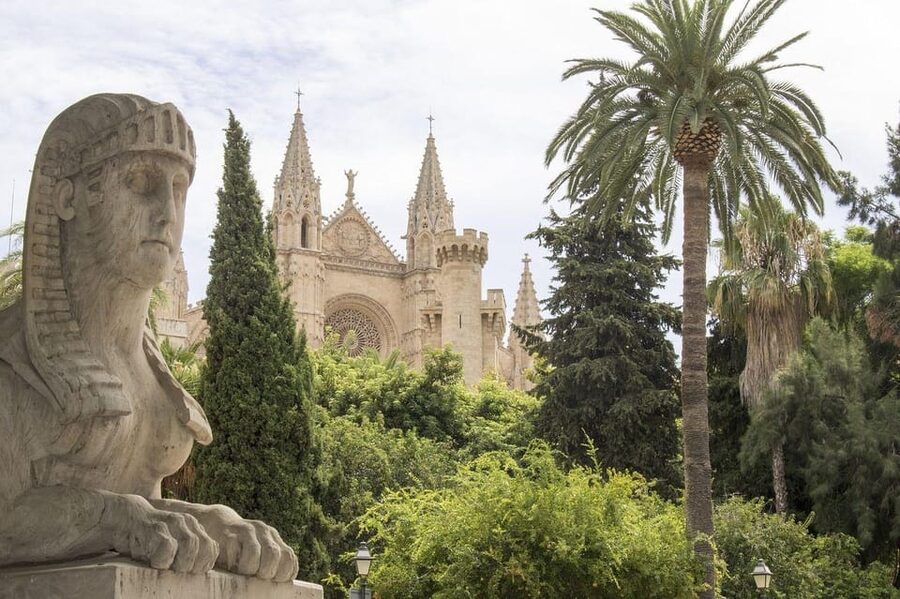
The Convent of San Francisco brings another major religious building into the walk. It is described as a Gothic convent dating from the 13th century, placing it among Palma’s earliest Christian-era landmarks.
Gothic architecture can be easy to admire without understanding, so this is a good place to ask your guide what to look for. You might focus on the building’s age, its religious purpose, or the way it fits into the medieval city around it. The tour information does not specify which parts of the convent are entered, so confirm the access arrangements during the walk.
This stop also helps balance the route. Santa Eulalia represents one medieval church, while San Francisco gives you a different religious foundation and a Gothic setting. You get more than repeated views of the same style.
The drawback is the same as with several stops on a short city tour: you will not have unlimited time for quiet looking. If you want to study architectural details or spend long periods inside, a private guide may help you prioritize, but 90 minutes still imposes a firm limit.
More walks around Mallorca:
- Palma de Mallorca: City Walking Tour with The Cathedral
★ 4.0 · 657 reviews - Palma de Mallorca: Foodie Walking Tour of the Old Town
★ 4.6 · 372 reviews - Palma, Cathedral & Valldemossa: Guided walking Tour
★ 4.1 · 182 reviews - Private walking tour in Palma de Mallorca with local guides.
★ 5.0 · 182 reviews
The Arab Baths and Mallorca’s Moorish past
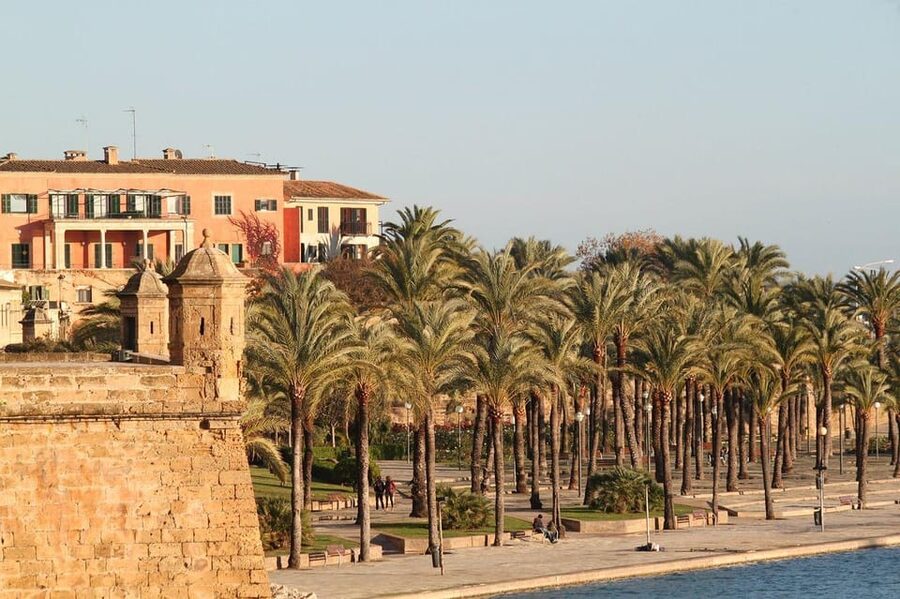
The Banys Àrabs, or Arab Baths, are among the few surviving reminders of Palma’s Moorish heritage. That makes them especially important within this route. Much of the city’s Islamic past has been changed, covered, or absorbed into later buildings, so a surviving structure gives the period a more tangible presence.
The baths also offer a useful correction to a common mistake in city sightseeing. Palma is not only a Christian medieval capital with attractive Gothic buildings. Its streets and monuments also reflect the period when the city was part of the Islamic world.
I would pay close attention here, since this may be one of the most distinctive stops on the route. Ask your guide to explain what the baths were used for and how they relate to the old city. The provided details do not specify the entrance fee or the precise amount of time inside, and admission is not part of the tour price.
Because the Arab Baths are a smaller surviving site rather than a giant monument, a guide adds real value. Without context, you might spend only a few minutes looking around. With explanation, the stop helps you picture a layer of Palma that is less obvious from the modern streets.
The Cathedral and La Almudaina across from it
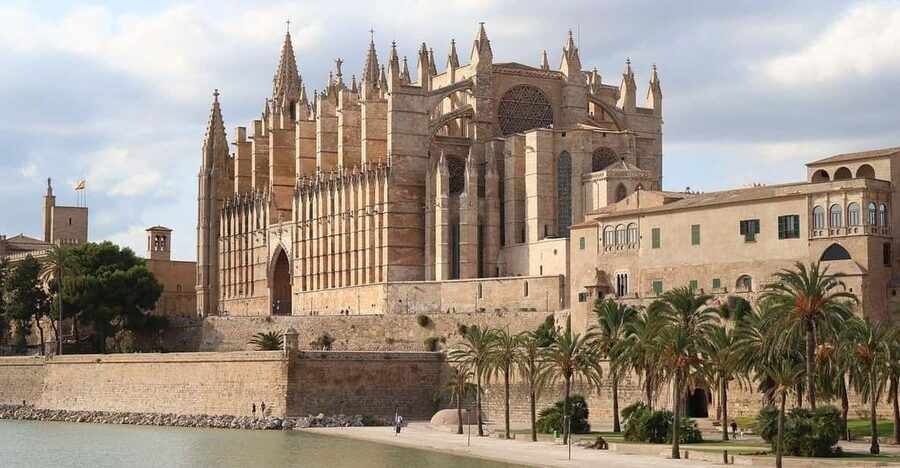
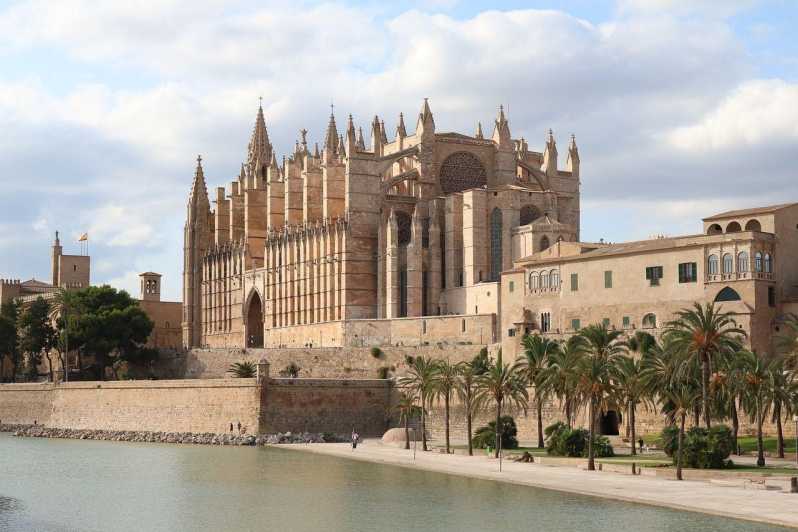
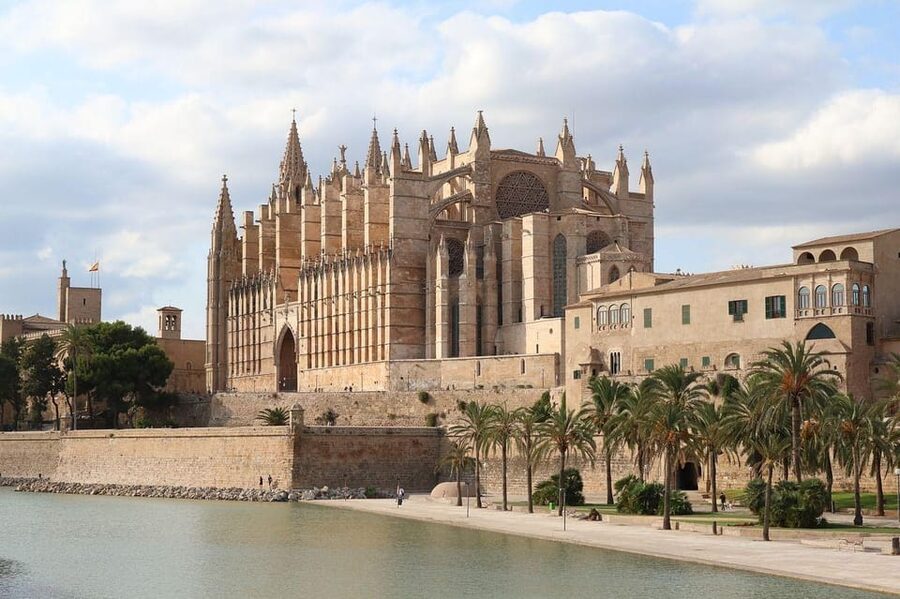
The Cathedral of Santa Maria of Palma is described as a 13th-century Catalan Gothic church built atop the former citadel. It is one of the city’s defining sights and an important point in the tour’s story of Christian Mallorca.
The cathedral’s position matters as much as its scale. It occupies a place tied to earlier defenses, so the site connects religious power with the city’s former fortifications. You can ask your guide to explain how the cathedral and its setting relate to the old citadel.
Across from it is the Royal Palace of La Almudaina, formerly the Alcázar of Palma. The palace began as an Arabian fortress and later became the official royal residence. The Spanish Royal family still spends summers there, according to the tour information.
Seeing these two buildings together makes the political change in Palma easier to grasp. One side represents the cathedral and Christian rule; the other preserves the memory of the earlier fortress and royal seat. The pairing is more useful than seeing either building in isolation.
The tour does not include entrance fees, so treat these as included sightseeing stops rather than assume you will tour every interior. If you want extended time inside the Cathedral or La Almudaina, you may need to arrange that separately and allow more time than this walking experience provides.
Medieval lanes, aristocratic homes, and public squares
Between the named monuments, the walk takes you through narrow medieval streets, aristocratic houses, baroque churches, squares, and markets. These transitions are important. Palma’s character comes from the spaces between the headline sights as much as from the buildings themselves.
Aristocratic houses point to the wealth and status of families who shaped the city. Baroque churches show that Palma kept changing long after its medieval period. Markets and public squares add everyday city life to a route that could otherwise feel like a parade of old stone buildings.
I like this part of the tour because it gives you a feel for Palma as a living capital, not just an open-air museum. You can compare the formal town hall with the tighter lanes nearby, then notice how the city shifts from civic buildings to religious sites and commercial spaces.
The route is described as a walking tour, so wear comfortable shoes and expect the old center to be explored on foot. No transport is included or needed for the stated route. The short duration makes it manageable, but it also means you should not expect a full tour of every market, church, and square encountered.
What the private format changes
The group is private, with a local professional guide accompanying only your party. That is a meaningful difference from a standard group walk. You can ask questions without waiting for a large crowd to move, and the guide can respond to the interests of your own group.
The experience also allows possible customization on the spot. You might ask for more attention to Moorish remains, Gothic architecture, royal history, or Palma’s modernist buildings. The description promises modernist marvels as part of the city’s broader character, though it does not name a particular modernist building or guarantee a separate modernist-focused itinerary.
This flexibility is most useful for families, friends, and people visiting Palma for a short time. It can also work well for a first afternoon in the city, when you want an overview before deciding where to return on your own.
There is a limit, though. A private guide cannot make 90 minutes longer. The more questions you ask at the early stops, the less time remains for later ones. If the Cathedral, Arab Baths, and La Almudaina are all priorities, tell the guide early so the route can be shaped around them.
Is $280 a fair price for 1.5 hours?
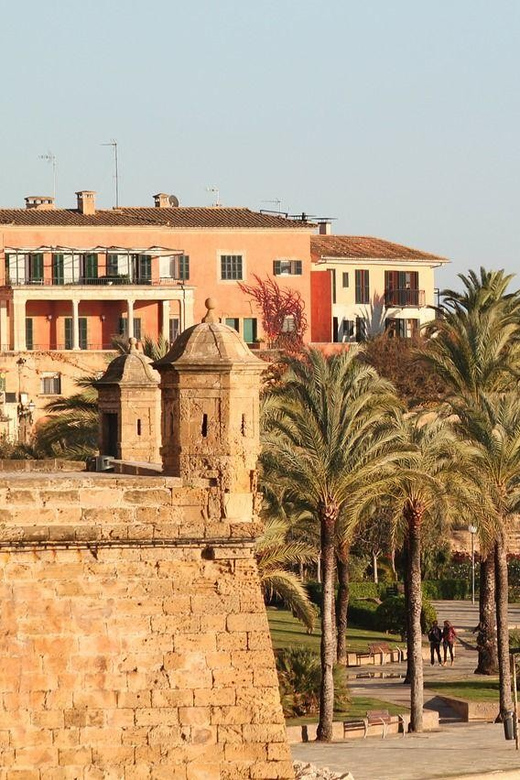
The cost is $280 per group of up to 15 people. That works out to about $18.67 per person if you have the full 15-person group. For 10 people, it is $28 each. For two people, it becomes $140 per person before any entrance fees.
That pricing makes the tour best value for a family, a group of friends, or a larger private party. For one or two people, the private format is pleasant but expensive compared with a shared walking tour. You are paying for exclusivity, a guide dedicated to your party, and the ability to shape the conversation.
Entrance fees are not included. That matters because the Cathedral, Arab Baths, or La Almudaina may require separate payment if you enter them. Ask about the planned admissions before starting so you understand the likely total.
The strongest practical value may come from using the tour as an orientation. You get the main historical framework, see where the major sights are, and can then decide which places deserve a longer return visit. That is more useful than trying to inspect every interior in one compressed outing.
Cristina’s helpful restaurant advice
A specific detail worth noting is the experience of guide Cristina. One booking party reported that she did an excellent job and recommended and reserved a very good restaurant after the tour.
That does not mean restaurant help is formally guaranteed for every booking, but it shows how a private guide can add practical value beyond dates and architectural labels. If dining is part of your plans, ask Cristina or your assigned guide for suggestions and make clear what kind of meal you want.
I would not book the tour solely for restaurant assistance. The main product is the historical walking route. Still, this is a useful benefit for anyone arriving without dinner plans, especially if the tour takes place near mealtime.
The overall rating is 5 from four reviews, with comments including a short, very positive German review and the specific praise for Cristina. That is encouraging, but the sample is small. I would treat it as a good signal rather than proof that every guide or departure will feel identical.
Who should book this Palma walk?
I would choose this tour if you want a private introduction to Palma’s old center and prefer a guide who can explain connections between different periods. It suits first-time visitors, families, small groups, and anyone with limited time in the capital.
It is especially useful if your interests are broad. You can cover Talayotic and Roman roots, Moorish remains, Christian churches, Gothic architecture, royal power, public buildings, and modernist touches without committing to a full-day museum program.
You may want something else if you prefer a slow, highly detailed visit inside each monument. The duration is only 1.5 hours, entrance fees are extra, and the exact amount of interior access is not specified. A longer private tour or separate museum visits would suit that plan better.
English is the stated tour language, and the group is private. Cancellation is free up to 24 hours before the tour, and you can reserve now and pay later, which gives you some useful flexibility when planning a Mallorca itinerary.
Should you book the Palma de Mallorca Private Guided Walking Tour?
Book it if you want a compact, private orientation to Palma and value conversation over a fixed audio-guide route. The Arab Baths, Santa Eulalia, San Francisco, the Ayuntamiento, Cathedral, and La Almudaina give the walk a strong range of sights, while the historical thread ties them together.
The value is strongest with a larger party. For two people, the $280 price is a serious consideration, particularly once entrance fees are added. For a family or group sharing the cost, the private guide and on-the-spot customization make the price easier to justify.
Arrive ready to walk, decide which sights matter most, and ask about interior access and admission costs at the start. If you do that, this tour can give you a clear first read on Palma, with enough useful context to make the rest of your visit more rewarding.
FAQ
Where does the tour begin?
It begins at the seating area of the Ayuntamiento city hall at Plaça de Cort, 1, 07001 Palma, Balearic Islands, Spain.
How long does the walking tour last?
The tour lasts 1.5 hours.
What language is the tour offered in?
The live tour guide speaks English.
Is this a private tour?
Yes. The guide is with your group only, and the group can include up to 15 people.
What sights are included in the route?
The route includes the Ayuntamiento, the Church of Santa Eulalia, the Convent of San Francisco, the Museum, the Arab Baths, the Cathedral of Santa Maria of Palma, and La Almudaina, along with medieval streets, aristocratic houses, baroque churches, squares, and markets.
Are entrance fees included?
No. Entrance fees are not included in the tour price.
Can the tour be customized?
Possible customization with your local guide is available on the spot.
How much does the tour cost?
The price is $280 per group of up to 15 people.
Can I cancel for a full refund?
Yes. You can cancel up to 24 hours in advance for a full refund.
Do I have to pay when I book?
No. The reserve-now, pay-later option lets you book without paying anything today.
Just added around Mallorca
- Discover the major cultural attractions of Palma De Mallorca on a Private Tour★ 4.5 · 3 reviews
- Wine Tasting – wines from the smallest wineries 3 wines★ 5.0 · 3 reviews
- Extreme e-scooter off-road excursions★ 5.0 · 3 reviews
- Full-day Tour to Drach Caves and Portocristo Town★ 4.0 · 3 reviews
- Gaudí and Modernist Art: Guided Tour in Palma de Mallorca★ 4.5 · 3 reviews
- Mallorca Beyond the Guidebooks – Tour with the famous Author★ 5.0 · 3 reviews
- Peguera: The lovely Magical Creatures of Peguera,family walk★ 3.1 · 3 reviews
- Mallorca: Speleo-Coasteering Tour along the Coast of Alcudia★ 5.0 · 3 reviews
Walking Tours, compared.

Palma, Cathedral & Valldemossa: Guided walking Tour
Read our review →
Private walking tour in Palma de Mallorca with local guides.
Read our review →
Food Tasting Walking Tour in Palma with a Local
Read our review →
2-Hour Private Walking Tour Through Palma’s Jewish Quarter
Read our review →
Browse the lists this tour appears in